Tuesday, 3 December 2013

The case for coloured socks

The Lakers with striped socks
Adding sleeves to jerseys is one way to give NBA uniforms more room for creativity. It mightn’t be the best way.

There’s not much to an NBA uniform; it’s generally a singlet and shorts. There are no helmets or caps, no long-sleeved shirts or pants, no gloves, no stirrups and no belts.

Of course, that’s not necessarily a bad thing. The Knicks’ road blues don’t look like they’re missing anything, for example, and the Celtics’ home whites aren’t begging for a green cap.

But having more to work with could theoretically lead to a better uniform. While it mightn’t be the motivation behind them, the new sleeved jerseys give teams more space for originality and differentiation.

The sleeves can house player numbers, for example, as will be done with the Christmas Day jerseys. They also give room for stripes, a patch or an alternate logo.

But sleeves still feel unnatural and too unnecessary to be justified. A better option for adding more to a uniform could be socks.

Teams used to wear long socks with team-coloured stripes. While a return to those socks could be a good look, it’s likely a little too farfetched to expect all NBA players to wear knee-highs.

Regarding farfetched: if the NBA were really interested in altering its approach to socks, it would have done something by now. But still, the idea of sock changes is worth considering.

Instead of the old style, teams could wear regular-length – or knee-high for those so inclined – coloured socks. Picture Golden State wearing yellow socks or New Orleans with red ones with their respective blue road uniforms.

Dallas could have a star on their socks. The Nuggets could use their crossed picks alternate logo and the Jazz could put their basketball note logo on theirs.

Washington could go with red, white and blue stripes.

There are of course potential problems. For it to best work, particularly with logos, the NBA logo would have to be removed from the visible part of the sock, something that seems particularly unlikely for the league to embrace. Plus the good work of striped socks could be undone by a player scrunching them down while playing.

It’d be mildly risky and it’s certainly unnecessary. With headbands and shooting sleeves commonplace, adding coloured socks to the mix could be overkill.

Socks are, however, more of an essential part of an NBA wardrobe than sleeves. Making them team-specific could be a subtler but superior choice than the sleeve option for giving teams more material to make their own.

Wednesday, 27 November 2013

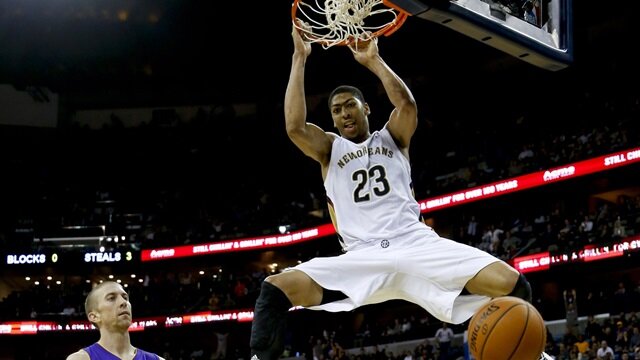
Anthony Davis, the "Leap," and the Peculiar Pelicans

Image courtesy of Derick E. Hingle/USA Today.
There is a fundamental set of expectations that are attached to the honour of being a number one overall pick. Anthony Davis, 2012 recipient of that label, is coping just fine with the weight of heavy scrutiny. Individually, his play in the 2014 season has been something to behold. Davis, fronting the freshly rebranded New Orleans Pelicans, is presently placed 2nd in the league's PER rankings, behind only LeBron James. League average for the Player Efficiency Rating measurement rests at 15.00, and through fourteen outings, the Kentucky product owns a figure of 28.35. Affixed firmly in the melange of one of the NBA's more obscurely-assembled rosters, he has been a near-solitary source of stellar play, and led the Pelicans' push to the fringes of the Western Conference playoff picture. Entering the season, Davis was considered a very reasonable candidate to make the "Leap" to the next echelon of performance, and inch closer to his ceiling as an elite player in this league.

Viewed as a gangly defensive pest with a raw offensive repertoire coming out of college, it is Davis' showcases of scoring and low-post manoeuvres that have come as the most pleasant surprises. Among those were a monster 32pt, 12 rebound, six block display in a win over the Lakers, and a 29 and 15 game in a Salt Lake City defeat. Furthermore, he's getting to the line six times per game, and drilling 85.1% of his chances - becoming somewhat of an anti-Dwight Howard at the charity stripe. This proficiency at the free throw line, and his ability to reduce his turnover count to just 1.4 per showing, is certain to please the New Orleans administration. The offense isn't all sunshine and rainbows, however, as the sharp uptick in minutes, added attention, and occasionally odd shot choice have caused a mild decline in his scoring efficiency (shooting 49.7% to this point). Understandably, the second year man is finding the majority of his points in the restricted area, scoring at a 64.6% rate (62 of 96) in that region, and struggling when he has attempted to expand his range. Although he may not be relied upon as a lethal outside shooter, developing the midrange game and fine-tuning his planted jump shot is clearly next on the offensive agenda. The below graphic depicts Davis' difficulties (granted, in only a limited sample size) when forced further and further away from the comforts of the interior. 

A brief overview of Davis' shot locations, in blocks of eight feet, per NBA.com/stats.
The Pelicans' prized big man is shooting 22 of 76, or 28.9%, on standard jump shots, overwhelmingly capitalising on dunks, flips, and tips, while weaving scattered hooks from the block into his arsenal. Ideally, an injury-free rotation with plentiful minutes for Holiday, Gordon, and Anderson, (plus bench contributions from the likes of Anthony Morrow and Tyreke Evans), would neatly balance the floor, and afford Anthony Davis slightly more breathing room from 15 feet and below. His usage rate is 21.7, slightly less than that of Tim Duncan, and narrowly missing out on the top ten for qualified power forwards. One would anticipate that this figure is at least a little skewed, and that the return of Ryan Anderson (who has now been active for five games), ought to level it out. Notwithstanding an aesthetically appetising scoring volume and a couple of tidy additions to the move set, Davis' devastation and dominance has transpired on the defensive end.

Indiana behemoth Roy Hibbert edges out New Orleans' unibrowed phenomenon by 0.07 for league-leading status in the blocks per game department, with the Pelicans' #23 deflecting 3.86 shots per game, on average. In addition to this, Davis is bunkering down in the paint at a level good enough for top five in the NBA (of eligible big men boasting steady minutes), minimising the conversion of opposing teams' shots at the rim to 42.5%. He is also inhaling rebounds in contested situations at a click superior to that of prolific glass-eaters such as Kevin Love and Dwight Howard, claiming boards in 45.3% of these cases, according to publicly available player tracking information. Assessing how he fares in a variety of front court tandems, though, carries certain value. It is perhaps most prudent to focus on the period in which Anderson has factored in - albeit a very limited one - due to the reality that NOLA were exposing the likes of Lou Amundson, Jeff Withey, and Greg Stiemsma to disproportionate minutes with the stretch four-man absent. Once again, the 2014 window of evidence is minute, but in terms of strategy, the proof is in the pudding: the Anderson-Davis duo is scoring at a handsome number, but is ultimately conceding 102.5 points per 100 possessions, per NBA.com numbers. On the season last year, over a 61 game span, the twosome's defensive reality was even more daunting, giving away 113.0 points by the same measurement. With this in mind, it becomes easier to understand why an Omer Asik-Ryan Anderson exchange has swiftly grown into one of the Internet's favourite imaginary trades. The thought of regularly aligning Anthony Davis with a true ball-stopping, intimidating low-post body must leave the other 29 teams shuddering. Alas, the Pelicans appear keen to latch their bills onto Anderson's canny and bountiful game, trusting their ability to plug the holes of the remaining minutes holes with one-sided, stopgap bigs.

The early season demonstrations of Davis have contributed to frequent player comps in the public domain, most notably with some seeing a resemblance between him and a youthful Kevin Garnett. High praise, no doubt, and reflective of the way in which Anthony Davis has captivated the attention of the NBA universe in this relatively young campaign. Unfortunately for New Orleans, their roster isn't comprised of thirteen Anthony Davis', and they are currently staring at a sub-.500 record, with a bevy of balancing issues. Of foremost concern for the Pelicans franchise would be the fact that their 6-8 mark comes after a 25th placing in the "Strength of Schedule" standings (ranking at .473), meaning that there's an inevitable uphill stretch from here. For the casual observer and those seen as strictly Davis admirers, though, it might just be best to heed the advice of Tony Montana from here on out, and look at the Pelican fly.

Tuesday, 26 November 2013

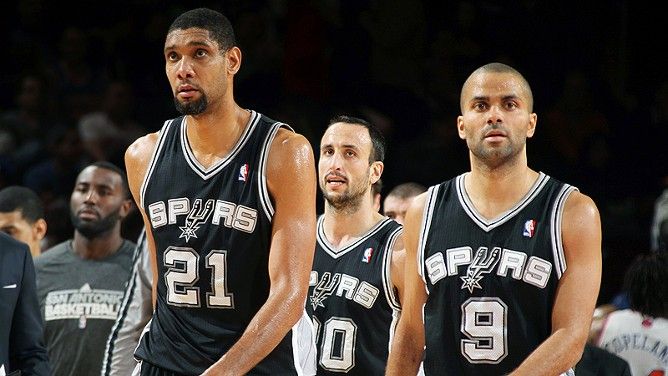
The San Antonio Spurs and the Art of Subtle Stability

Image courtesy of Nathaniel E. Butler/NBAE/Getty Images.
The Spurs are 13-1, leading the Western Conference, riding an eye-popping, pace-setting 11 game winning streak, and yet, this is not news. Fourteen games into the regular season marathon, the silver and black hold a 93% winning ratio. Whilst some have sought to assess and scrutinise the legitimacy of the Trail Blazers' wildly hot stretch (and rightfully so), San Antonio continues it's excellence of execution in this, Tim Duncan's 17th season, stereotypically unnoticed and absent from public fandom and consciousness. Duncan, participant in a total of 1192 regular season bouts and 211 postseason showings, has featured in twelve of the team's 14 games thus far, and remains the centrepiece of the ever-reliable San Antonio locomotive. "The Big Fundamental" logged a cumbersome 2,813 minutes across standard and playoff contests last year, and is certain to have his court time intricately managed and carefully placed, yet again. It is almost as if basketball enthusiasts have become so blissfully accustomed to the recurring success of the franchise from the Southwest of Texas that it casually seeps through the everyday clutter of talking heads, and acquiesces to a status of lesser importance.

This season, it seems, has been no different. The insignia of the team's offensive output has, in a more recent context, proven to be remarkable spacing, copious amounts of shooters, and the usage of Tony Parker's penchant for slashing as the instigator for fluid, intelligent passing. It's early, to be sure, but the Spurs currently rank 4th in the league for assists per game, and 61.7% of the team's converted field goals directly result from teammate setups. Historically, San Antonio have found a way to implement solid, accomplished, bit-part, veteran contributors into their polished schemes, whether it be Robert Horry, Brent Barry, Glenn Robinson, Michael Finley, Fabricio Oberto, Boris Diaw, Stephen Jackson, Matt Bonner, or any other member of the Spurs' assorted casts who honed in on a regular role. Perhaps the 2013-14 version of this concept will be Italian guard Marco Belinelli, formerly of the Chicago Bulls. Of course, these names arrived in San Antonio with differing resumes and achieved varying levels of success once competing in a Spurs uniform, nevertheless, there is enough of a track record to trust in the managerial ingenuity of this front office. These complimentary pieces have allowed Popovich's men to take advantage of the roster's balance and flexibility, and experiment with new structures on both sides of the ball. 

The Spurs stand at 7-0 on their home floor, with a hearty net-rating of +15.0, and a handy pace of 96.92 possessions per 48 minutes, according to NBA.com statistics. These healthy numbers are reflective of the regenerated offense that vaulted the team to a 61-win, #1 seed season in 2010-11, followed by a Conference Finals placing in the 2012 season, and earned them an NBA Finals berth this past June. This season, San Antonio have registered a number of double-digit victories, including a pummelling of a Cleveland outfit in utter disarray just three days ago, and a 31pt romp of New York at Madison Square Garden. The win over the Cavaliers, according to Alex Kennedy of HoopsWorld.com, is the 37th time that the team has amassed that margin of victory (min. 30pts) in the Tim Duncan era. Kennedy noted that this is equivalent to eight more of those wins than any other NBA franchise in that window. It is comprehensive routs of this nature that create the luxury of resting key, ageing players for the Spurs, the significance of which simply cannot be overstated. 

Distinct from the offensive prowess of Duncan's squad, the tangible defensive presence of Tiago Splitter, forever lurking in the paint, is not to be dismissed. Analysis of San Antonio's two-man lineup figures highlight that Splitter, in almost any pairing (even with reserve guard Patty Mills), is able to heavily deteriorate the conversation rate of opposition scoring attempts. Measured on a per 100 possessions basis, Splitter (thus far), when paired with any of Mills, Manu Ginobili, Marco Belinelli, Boris Diaw, Kawhi Leonard, or Tony Parker, assists in restricting the opponent's field goal percentage below a meagre 41%. Splitter's role as a stalwart in the post is a primary factor behind the limiting of Tim Duncan's minutes to a career-low 27.3 per game. The sturdiness contributed by Splitter, in congruence with the creativity and unconventional play of bench bigs Boris Diaw and Matt Bonner, gift the Spurs the chance to rest their 37 year old future Hall-of-Famer extensively, and rely on guard-heavy units that look to compensate for the loss of Duncan's multifaceted offensive production. Behind all of this, clearly, is a conscientious strategy to pick spots on the floor, utilise the corner three as a predominant weapon, and maximise the value of good, well-balanced shot selection.
San Antonio's shot distribution chart through fourteen regular season games.
The above diagram illustrates the offensive decision-making of the Spurs to date, amplifying explicit points of emphasis. The shades of blue (ascending from below to above league average) portray how the team fares when compared to the remaining 29 squads, with the left baseline/block semi-circular region and three-fifths of the available three-point territories obviously favoured. Conversely, they appear to hold a deliberate aversion to the top-of-the-key region, hesitating to launch "long twos", widely acknowledged as some of the (statistically) least efficient spots to fire from. It is not difficult to fathom how this team has developed into an unequivocal offensive juggernaut, artfully whisking together heady play with above-average shooting capabilities. As a collective, San Antonio is nailing an average of eight threes per game, at a scary rate of 40.5%, in addition to owning quality percentages both at the line, and from the field. Tony Parker, perennially an undersized problem-maker in the paint for opposition teams, is leading the league in field goal percentage on drives (of players averaging at least 30mpg), netting an absurd 67.9% of his driving tries, per SportsVU player tracking data. Moreover, three of the Spurs' regular backcourt rotation (Parker, Danny Green, and Patty Mills) feature in the top ten in the NBA in average speed traveled (measured in miles per hour), ranging between 4.6 and 4.8mph, helping the team to counterbalance the low-post play of Duncan with a host of speedy, tempo-pushing guards. This is an offense unparalleled in its diversity and complexity, regularly punishing subpar opposing defenses and assaulting the basket from an assemblage of angles.

With this, and the spectacular defensive impact of the Splitter-Duncan combination (Splitter stifles the interior, limiting opposition FG% at the rim to 32.8% - good for league-leading status of those playing 20+ minutes and regularly contesting shots), San Antonio is set. In an odd way, having considered all of the above, it is unsurprising that the win-loss ratio is 13-1 to this point - indirectly feeding into the absence of popular attention. The ideal, perfectly scripted scenario would be a top two seed in the West, with a healthy core entering the postseason. Evidently, it is health - and not consistency of performance - that will persist as the overwhelming concern. To the basketball junkie, it is tough not to appreciate the unique beauty and unmatched dependability of the San Antonio Spurs.

Hornets colour scheme might not work

The Charlotte Bobcats announced on Sunday the colours they’ll wear next season as the Hornets. Purple and teal are the primary colours, while grey, black and light blue are the secondaries.

It’s unsurprising news. The franchise is reinstating the Hornets nickname in Charlotte, so it figures they’d reinstate the corresponding primary colours, too. Plus, the original Hornets colours are distinctive and popular.

The original Hornets while in Charlotte never abandoned or deemphasised purple or teal. Other teams that had used one of those colours did move away from them, such as the Toronto Raptors, Memphis Grizzlies, Arizona Diamondbacks, Miami Marlins and Anaheim Ducks. Perhaps the Charlotte Hornets would have too had they stayed in town beyond 2002. But they didn’t, so that probably adds to purple and teal being a special combo in Charlotte. It wasn’t just a fad.

Even if it seemed inevitable, bringing back purple and teal is probably a good move.

The primary uniforms of the original Hornets in the first half of the 1990s showed that purple and teal can work well when the rest of the uniform is restrained. That means no side panels and a fairly basic word mark and fonts.

The purple alternate they wore in the mid-‘90s looked sharp. A similar alternate for the new Hornets could work well.

The secondary colours of the scheme for the new Hornets are, unlike the primaries, a reason for concern.

Road uniforms of the original Hornets
The grey, black and light blue could be subtle enough to not be an issue, or some of the colours mightn’t appear on the uniforms at all.

But it’s also possible that they’ll be too prominent, clashing with the purple and teal and robbing the unis of the restraint that’d suit them.

Piping up the side of the uniform, like what the Bobcats have worn, would be one way for these secondary colours to be utilised to the detriment of the unis.

Remember the negative trajectory of the Bobcats franchise uniform-wise, too. Their initial uniforms in 2004 were pretty good considering they had few classic elements. Their gear then got blander until arriving at their current unfortunate set, replete with forced light blue, a “CATS” word mark and busy sides. The franchise isn’t in the habit of making their uniforms better.

The return of purple and teal could be a good thing, but there’s plenty of room for error.

Tuesday, 19 November 2013

Trail Blazers uniforms can withstand changes

The Blazers' road uniform
The Portland Trail Blazers are considering uniform changes for 2015-16, according to Blazer’s Edge. Contemplation of whether their current set requires tinkering seems appropriate, then.

To put it briefly, no changes are necessary. In fact, the Blazers have one of the best home and road sets in the league and are proof that good basic uniform elements can withstand alterations.

Their current home and road set breathes rare air: it’s interesting while staying understated and attractive.

The scoop collar looks great and, as their red alternate’s unflattering collar proves, is a significant factor is these uniforms’ success.

On that red alternate: it’s ok, but using the stripes from the homes and roads would be an upgrade on those tapered ones and removing the logo from the neckline and ‘rip city’ from the shorts would be an improvement, too. The "Rip City" alternates, meanwhile, are a hindrance to the Blazers' set.

Back to their current home and road set. The diagonal stripes on the jersey and vertical ones down the left of the shorts are a simple but appealing element, boosted by the Blazers’ colour scheme. The clean right side of the uniform is a nice, anti-clutter move.

The fonts for the word mark, player’s name and number are acceptably plain so as not to take away from the rest of the uniform elements.

All that written, a tweak or two is not to be feared. The Blazers have shown that.

The word mark and number font had drop shadow from 1991-2002. There also wasn’t a silver stripe then, just red and white. The word mark on both the homes and roads used to be red and in lowercase. And for a long stretch they went with a coloured waistband.

So the impressive uniforms we see today are the product of some slight modernisations.

If the Blazers maintain their colour scheme and designations and keep the scoop collar and the diagonal stripes, it’d be hard for any adjustments to render their set unattractive.

Wednesday, 13 November 2013

In the Garden of Uncertainty

Fading away: Just like the hightop, gone is the Knicks brass' confidence in Iman Shumpert.
How much can one honestly say about the reeling, bizarre New York Knicks organisation? The traveling sideshow that is the Knicks took yet another wild spin into trademark insanity Wednesday, with the news that J.R. Smith will start in place of Pablo Prigioni in Atlanta, the swirling rumours of Mike Woodson and the front office's dissatisfaction with Iman Shumpert, and subsequent trade whispers. Firstly, Smith. The cartoon-esque saga that has been his last six months - whether it was his playoff meltdown and elbow to Jason Terryhis odd contract negotiations that changed in length and dollars (significantly), his not-so-subtly masked offseason knee surgery, his five game suspension for a violation of the league's anti-drugs policy, the unbalanced addition of his sibling (Chris Smith) to the roster, or his awful return game which saw him net 5pts on 1-9 shooting in a 31pt home loss - rolled on uninterrupted again today, as he steps in to start just his second game in 117 showings for the Knicks. Smith, ever the controversial figure, seemingly has the support of Mike Woodson, and will confirm what had apparently been brewing in the summer months by starting tonight's road game against the Hawks. Shumpert retains his position, for now, as it is the efficient Pablo Prigioni - who, by contrast, does not have the enduring adoration of Woodson - set to step aside. Of course, never mind the fact that across eight games in April of last season the Felton-Prigioni-Shumpert-Anthony four man unit managed a net rating of 18.8 and a true shooting percentage of 63.8%. Moreover, since being inserted as a regular starter on March 18, Prigioni assisted the Knicks on a 16-1 stretch over the month of March and April, including 13 straight victories. The decision to tinker the lineup prior to Wednesday's matchup represents the fourth experimented starting unit in only eight total games. In other words (even with Tyson Chandler's untimely injury), the word 'stability' has not been synonymous with the 2013-14 Knickerbockers thus far.

Timing and justification notwithstanding, J.R. Smith will seek to recapture the level of play that earned him the honour of being the NBA's premier bench performer, as the 2012-13 Sixth Man of the Year. In his 'contract year', Smith registered 18.1 points per contest whilst connecting twice from downtown per game, frequently amassing starter-quantity minutes (33.5mpg). His 5.5 long range hoists per game, however, were second only to league-leading scorer Carmelo Anthony, who attempted six per outing. After a smoking opening to his team's first round series, Smith crumbled in the wake of his league-imposed suspension, only managing 33.1% field goal shooting and 16.1 points per 36mins. Clearly, the majority of Smith's NBA successes have surfaced in a role where he is asked to deliver sharp, immediate offensive spark and can be withdrawn with little consequence, rather than as a proverbial second banana. The reliability of J.R. Smith as a #2 offensive option remains in serious doubt, and if that is underlining the thinking of his placement in the starting five, then the Knicks' officials may be startled by the outcomes. Apparently, the re-emergence of Smith from injury and suspension, the drafting of the walking trebuchet Tim Hardaway Jr. in the first round, and the inking of wily guard Beno Udrih to complement the roster's guard depth have deemed perimeter defender and chief young asset Iman Shumpert expendable. 

Frank Isola of the NY Daily News reports that New York have put the feelers out and tested the waters in relation to Iman Shumpert's trade currency, engaging in preliminary discussions with Denver. The news is not altogether surprising, yet it stands as indicative of the organisation's hasty, remarkably shortsighted strategising. As a result of age, contractual status/salary cap hit, injury, and team roles, Shumpert is undoubtedly the sole asset of any substantial worth in the trade market that the Knicks can lay claim to. Isola notes that the front office, absorbing the blows of Chandler's extended absence, is attempting to conjure a solution to its barren front court situation. Shumpert, attached to a rookie-scale deal, comes at the very modest price of $1.7M for this season and $2.7M next, only serving to heighten his value in trade conversations. If the reports are even vaguely true, and New York is gauging the possibilities of a Shumpert-big man exchange - Isola mentions Denver's Kenneth Faried as a candidate - one ominous truth appears to be eluding the team's officials. In (hypothetically) disposing of Iman Shumpert, the Knicks will have a grand total of zero quality, NBA-capable wing defenders under the age of 34, leaving an already-dire defensive circumstance to be hammered by a weakened, shallow rotation. The unquestionably positive defensive influence of the third-year man was made clear for all to witness and appreciate in the 2013 Playoffs, with his on/off-court differentials a reminder of this. In twelve postseason matchups, the Knicks' net rating with Shumpert on the floor was 7.6, while when he headed to the bench, it was a mere -3.3. Realisitcally, New York will have great difficulty discovering that level of defensive efficiency in any bigs available in Shumpert-centred discussions, nor will they be able to plug in above-average, short-term replacements from the free agent pool in the aftermath of any possible trade. 

Amidst all of this chaos and disorganisation, one thing becomes clearer as each game passes - the Knicks are tightly lodged with a small-ball, floor-spacing, undersized roster, sewn to a coach who is, fundamentally, an advocate of slow-it-down, front court focused, post up play. Woodson, in the face of all forms of cheery outcomes for his 'Prigionian' (new word) lineups, will do anything to escape the unwanted condition of a guard-heavy roster, almost to the point of sheer stubbornness. Having said that, with Chandler sidelined, the Knicks' coach is inherently handicapped and will be left to continue to start Andrea Bargnani - owner of an underwhelming -16.6 on/off-court differential - at centre

The storylines of Smith, Shumpert, and Woodson himself, are not likely to dissipate any time soon. Frank Isola of the Daily News seems determined with his take that Shumpert will be discarded via trade, sooner or later, and if Chandler's stint in a suit and knee brace is extended in the slightest, expect the Knicks to reshuffle their collection of bigs. 

Tuesday, 12 November 2013

A look back at graphics on uniforms

The Pistons during the horse logo days
There’s a distinct lack of graphics on NBA uniforms these days. That’s probably a good thing. Here are some examples of teams employing graphics on their unis, something of a trend in the ‘90s that yielded some unflattering results.


Atlanta Hawks, 1995-1999

The home and road versions vary in quality. The home whites look pretty good, although the lettering isn’t all that clear. The roads suffer from the unflattering colour fade effect.

Detroit Pistons, 1995-2001

The horse fits with the lettering and on the jersey nicely, but would probably look better without the flames. The set as a whole is unattractive, particularly those numbers.

Milwaukee Bucks alternate, 1995-1999

The shadowy effect, interference with the jersey lettering and the colours are the biggest issues here. The fact the buck is different to the one in their logo at the time is a negative, too.

Philadelphia 76ers, 1991-1994

The 76ers with multi-coloured stars
This could’ve looked good had they made all the colours solid instead of faded. The result is a kind of metallic, computer-generated look.

Phoenix Suns, 1992-2000

An example of graphic success. The angle and colouring work, as do the sun streaks and spikes. The basketball is the weakest element, but it’s acceptable.

Toronto Raptors, 1995-1999

The raptor looks good and is taken from their logo, but that graphic makes an already busy uniform  with pinstripes, shorts logos and nameplate spikes  even busier.

Utah Jazz, 1996-2004

This set suffers from fade and colour problems, particularly the road unis. The set would’ve looked pretty good had they used just a mountain outline on the roads and cleaned up the lettering.
 

Employing graphics could be worthwhile today if teams avoided the fade effect and colouring issues that damaged some of the uniforms mentioned and used relevant and clean graphics. Atlanta, for example, could go with the hawk from their logo underneath clean lettering with the number in the top corner of the jersey.

It’s far riskier than a traditional approach, but it’s a way for teams to have an attractive and different look.